Warning: this story contains descriptions of a public execution.
The people of the State of Wisconsin, represented in Senate and Assembly, do enact as follows:
Approved, July 12, 1853.
SECTION 1. In all convictions under the statutes of this State, for the crime of murder in the first degree, the penalty shall be imprisonment in the state prison, during the life of the person so convicted; and the punishment of death, for such offence, is hereby repealed.
Shortly after Wisconsin became a state in 1848, the legislature authorized the construction of the state prison in Waupun. This facility, which would open its doors in July of 1851, provided a crucial alternative to capital punishment. Notably, Wisconsin had a long-standing opposition to the death penalty, with discussions even occurring at the state’s constitutional convention regarding its abolition. The opening of the Waupun prison paved the way for life imprisonment sentences, ultimately leading to the complete abolition of the death penalty for all crimes on July 12, 1853. This landmark decision marks the longest-lasting abolition of capital punishment, for all crimes, in the United States, with over 170 years and counting.¹
However, between 1853 and 1885, Tribal governments still retained jurisdiction for serious crimes committed within their reservation boundaries by tribal members (The federal courts only had jurisdiction on the reservations for major crimes in cases where the defendant was not a tribal member).² This meant the tribe was responsible for the trial of the accused and the punishment of the guilty.
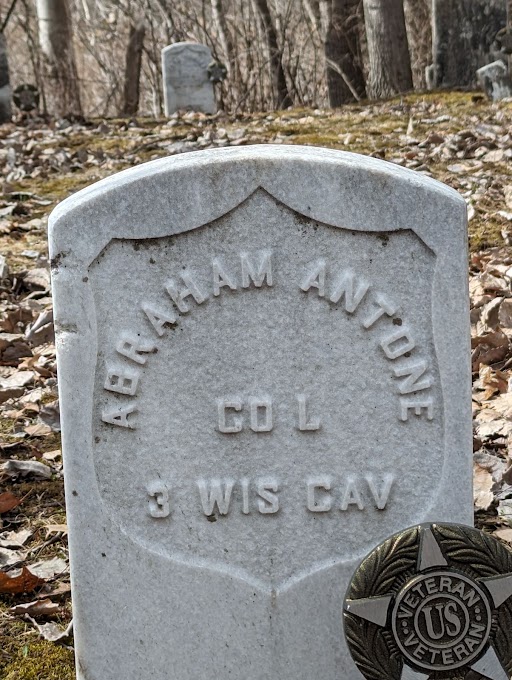
Fifteen years after the abolition of the Wisconsin death penalty, during this 32-year window, Abraham Antone was murdered by Jacob Powless on the Oneida reservation. The case, which involved, two native Americans fell squarely under tribal jurisdiction.
Twelve chiefs acted as the jury, and the principal witness against Powless was his wife, who witnessed the whole incident³. Jacob Powless pleaded insanity but it was to no avail, there were previous reports that Powless had been considered a “bad man” in the past and that it was suspected he may have been guilty of more murders than just Antone’s⁴. It was a short trial and he was found guilty.
Sentencing would be less clear cut though. Unlike the state of Wisconsin, the Oneida nation lacked a prison, significantly limiting their available punishment options for serious crimes. The Chiefs even appealed to Governor Fairchild⁵ to permit Powless to serve a life sentence in the state prison, but those efforts failed. At first, they didn’t know how they should kill him, maybe shooting him would be preferable, but they eventually settled on a hanging. The date was set for Friday the 13th, November 1868.
“When I was about nine years old the most horrible surprise I had was to see a man named Big Jacob hanged. He was hung at two o’clock in the afternoon. Early in the morning the people began to pass our house going to the place where the man was going to be hung. Lots of white people and Oneidas together were going there. There was a mob of people there. The minister offered a prayer then they allowed the Big Jacob to say whatever he felt like saying. He said, “I have committed a great crime, and that is why I am standing here in front of you. Don’t ever commit such a crime.” Then he was hung. That was the last time they hung anyone here. The white officials said that it was against the law of Wisconsin. This happened about sixty-eight years ago.“
Celecia Hill, being interviewed by Ida Blackhawk [1939]
The following excerpt is from the Green Bay Advocate:
“At the hour appointed, pretty much all the tribe, including the women assembled on the crest of the hill on the west side of the Episcopal cemetery at the foot of which the ‘swinging paraphernalia’ was placed. The chiefs, with the exception of one or two, were present, while one who was mounted, to take charge and give commands which commands were promptly attended to. A hollow square was formed- a detail of Oneidas, armed with guns and bayonets officiating as guards. At 3 o’clock, the prisoner was brought down in a wagon to the side of the scaffold dressed in a white gown and cap. Prayers were offered by the Episcopal missionary there, and then several came forward, including the prisoner’s wife and mother, to shake hands and say good-bye. As he sat on his coffin in the wagon, not a trace of fear- not an emotion was exhibited – but there he sat, sustained no doubt with that stoicism and seeming indifference, so common to the red man. Shortly after he ascended the scaffold- a construction similar to that used in States where hanging is permitted- and sat on a chair, looking around him with the utmost composure. On expressing a desire to see the inside of his coffin, it was opened, when he coolly surveyed it, appearing perfectly satisfied with its construction. He then arose and spoke in his native tongue, the translation of which is as follows. Between each sentence there was a pause :
‘My friends, I wish you would conduct yourself better than I have.
Let whiskey alone. If you do, you won’t be in my situation.
There is a rope around my neck.
And it don’t look well.
You look better without it.
I ask my mother and sisters not to shed a tear over me.
I am prepared to die.
I ask my Heavenly Father to forgive my bad deeds.
I trust the Lord will forgive me.
Now I bid you all good-bye.’
His hands and feet were then tied and he was told that he had but four minutes of time left. He then, in a low gutteral voice repeated the Lord’s prayer in the musical language of the Oneida. Mr Goodenough commenced reading the service during which the prop was knocked out and Jacob Powless was on the confines of eternity. He struggled but little, although it is probable his neck was not broken. After hanging fifteen minutes his body was cut down and buried immediately in a corner of the cemetery.”
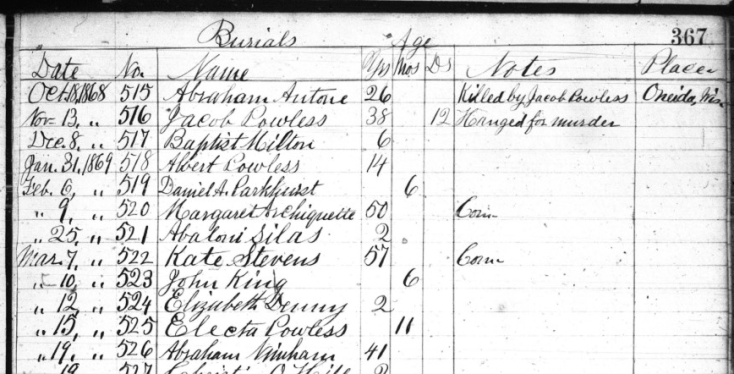
Image Courtesy of UW-Green Bay Archives
John McCaffary’s hanging in Kenosha on August 21, 1851, is commonly cited as Wisconsin’s last legal execution. However, Jacob Powless’s hanging in Oneida, though not governed by the state, occurred 17 years later and was carried out in accordance with the law.
Interestingly, a contemporary loophole in capital punishment still exists today and allows the federal government to impose the death penalty even in states where it is outlawed. This means a federal inmate could technically be executed within Wisconsin’s borders, provided it occurs at a federal facility. Such an event transpired in Michigan in 1938, despite the state having abolished the death penalty in 1846¹. Nevertheless, this scenario is unlikely in Wisconsin as the state does not house federal inmates on death row.
Today both Abraham Antone and Jacob Powless, Civil War veterans and members of the Oneida Nation, are interred near each other at Holy Apostles Cemetery in Oneida, Wisconsin, the site of Powless’s execution.
Footnotes
¹ “In 1853, Wisconsin abolished the death penalty for all crimes. At that time, only Michigan (1846) and Rhode Island (1852) had previously abolished capital punishment for murder (Michigan retained it for treason until 1963). Rhode Island went on to legalize capital punishment in 1872 (only to abolish it again in 1984). Wisconsin’s bold decision in 1853 stands as the longest-lasting abolition of the death penalty for all crimes in the United States, with over 170 years and counting.”
Blood for Blood Must Fall by Daniel Belczak [2021]
² This remained the status quo until the Major Crimes Act of 1885, which granted federal courts authority over major offenses such as murder, rape, and assault within “Indian Country” even if the defendant was Native American. Today, the state of Wisconsin has legal jurisdiction over the Oneida reservation through Public Law 280.
³ Unlike the state which offers protections for spouses from giving evidence against their husbands, the Oneida court offered no spousal protection.
⁴ Green Bay Advocate Nov 12, 1868
⁵ Green Bay Advocate Nov 12, 1868
Other sources
Diary of John Archiquette – English Translation
Blood for Blood Must Fall by Daniel Belczak [2021]
A Collection of Oneida Stories by Maria Hinton
WPA Papers 1939
 Old Green Bay
Leave a comment